When homeowners move past stock cabinets and begin exploring higher-quality options, they quickly encounter two terms: semi-custom and fully custom. These categories are used frequently in the kitchen industry, but the distinction between them is not always clearly explained. Understanding the differences in construction, flexibility, pricing, and lead time will help you determine which approach is right for your renovation.
What Is a Semi-Custom Kitchen?
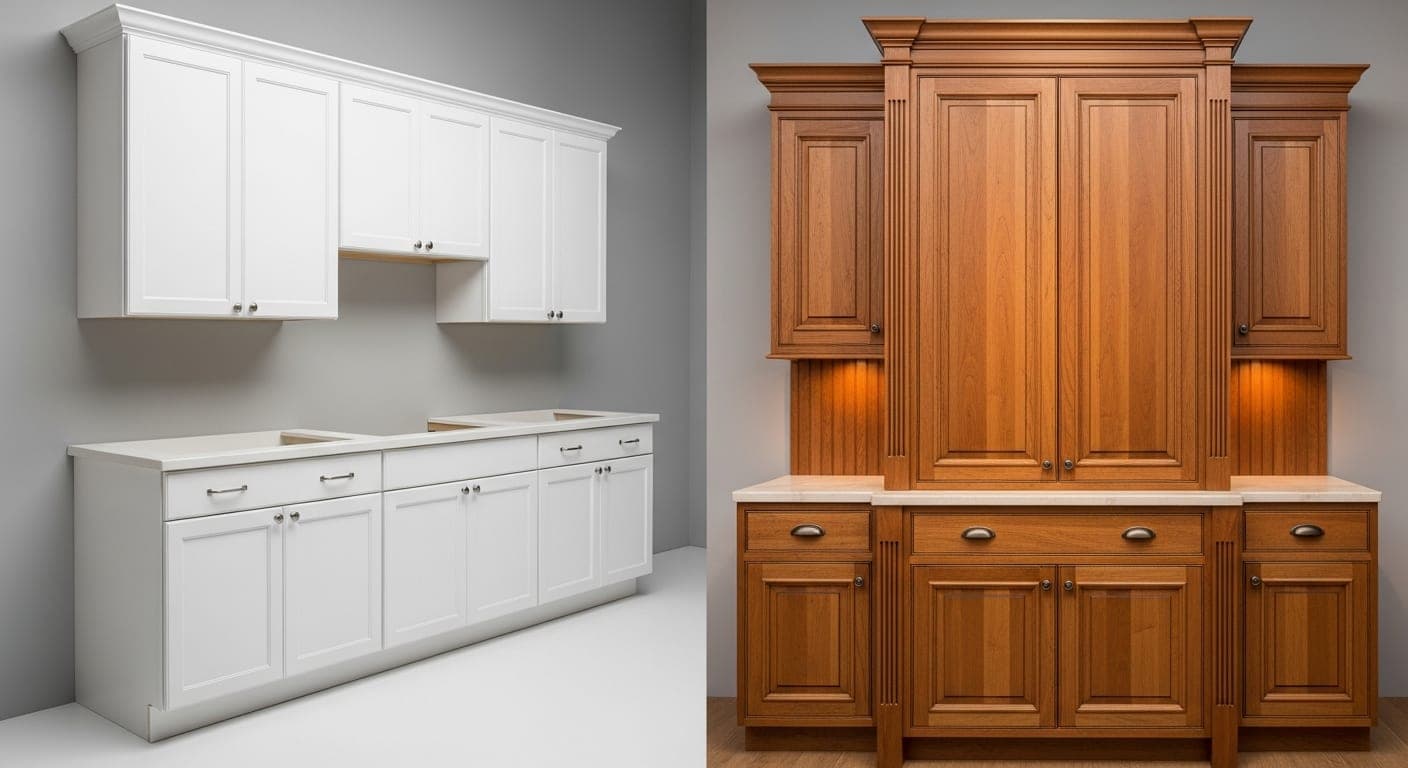
A semi-custom kitchen starts from a manufacturer's catalogue of standard cabinet sizes, door styles, and finishes. Within that framework, you can make modifications. Typical semi-custom options include adjusting cabinet depth or height within a defined range, choosing from an expanded selection of door profiles and colours, adding interior accessories like pull-out trays or drawer dividers, and selecting from multiple hardware options.
Semi-custom cabinets are manufactured in a factory setting using standardized production processes. The base cabinet units follow established designs, and your chosen modifications are applied during production. This approach allows the manufacturer to achieve economies of scale while offering homeowners more choices than stock cabinets provide.
The resulting product is a significant step up from stock cabinetry. Construction is typically better, with plywood or furniture-grade MDF boxes, and hardware is generally higher quality. Door styles and finishes cover a broad range that satisfies most design preferences.
What Is a Fully Custom Kitchen?
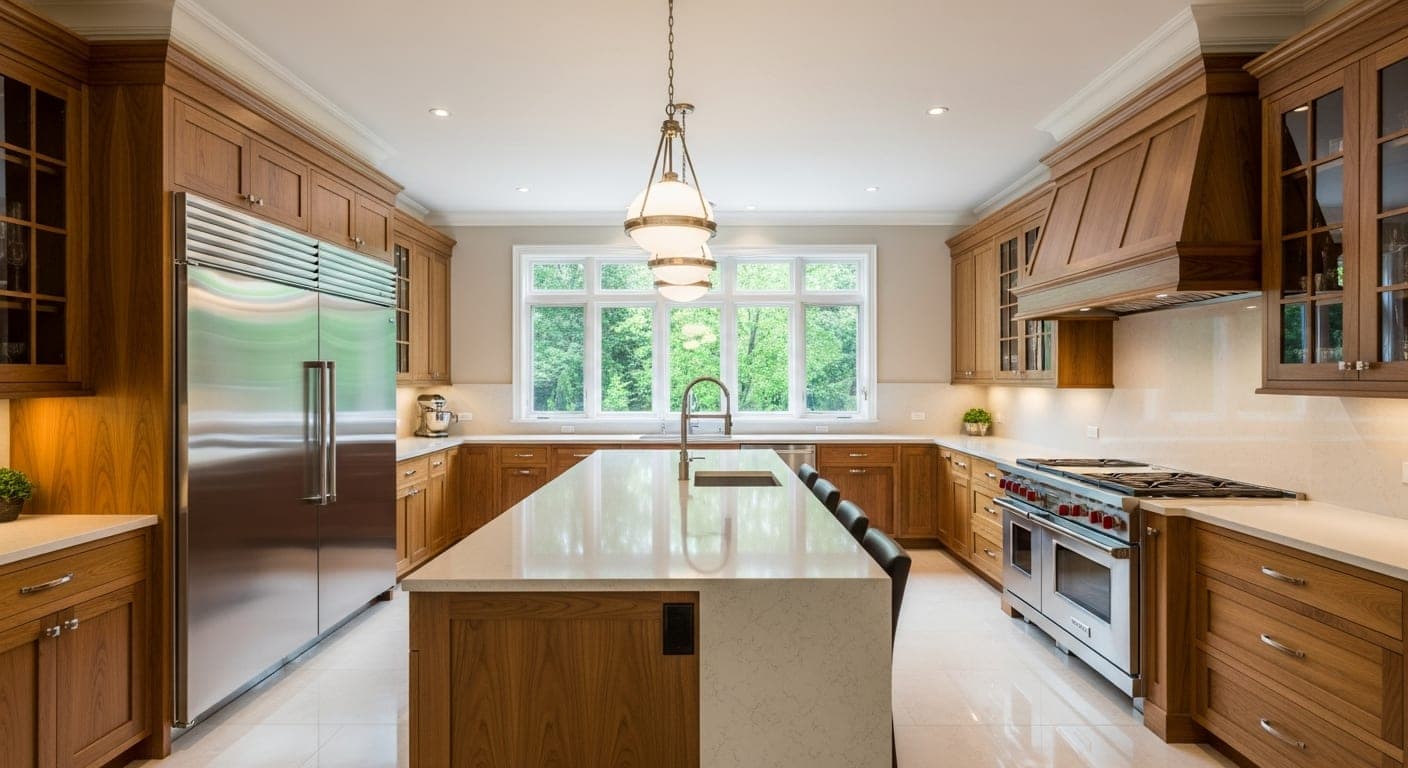
A fully custom kitchen is designed and built from scratch for your specific space. There is no catalogue of standard sizes. Every cabinet is engineered to the exact dimensions required by your kitchen's measurements, your storage needs, and your design vision.
The design process begins with detailed on-site measurements and a thorough conversation about how you use your kitchen. From there, each cabinet is drawn individually, specifying its precise width, height, and depth along with the door style, material, finish, hardware, and interior configuration.
In a fully custom kitchen, there are effectively no constraints beyond the laws of physics and your budget. You can specify a cabinet of any dimension. You can mix materials within the same kitchen, using solid walnut for an island and painted MDF for perimeter cabinets. You can incorporate unconventional elements like integrated display lighting, curved cabinet faces, or furniture-style details. The hardware, from hinges to drawer systems to specialty mechanisms, is selected specifically for each application.
Key Differences
The practical differences between semi-custom and fully custom become apparent in three main areas.
Materials and Construction
Semi-custom manufacturers typically offer two to four box construction options and a fixed list of door materials. You choose from what is available. Construction methods are consistent across the product line, which ensures reliability but limits specialization.
Fully custom cabinetry allows the maker to select construction methods and materials based on the specific requirements of each project. A cabinet designed for a humid location near the dishwasher might use marine-grade plywood, while a pantry in a dry area might use a different sheet good. Door materials range from standard hardwoods to exotic species like zebrano, cherry, and walnut.
Finish options illustrate the difference clearly. A semi-custom line might offer 30 to 50 paint colours and a selection of stains. A fully custom shop can match any colour you specify, apply multi-step finishes including glazes and antiquing, and use industrial cabinet-grade coatings that deliver superior durability and depth.
Sizing and Fit
This is the most significant practical difference. Semi-custom cabinets are modified from standard sizes, which means adjustments happen within defined parameters. If a semi-custom manufacturer offers base cabinets in three-inch or even five-inch width increments, you cannot order a cabinet that is 13.5 inches wide. This leads to the 'Filler Strip' Issue: large gaps that must be bridged with 8-inch filler strips, wasting prime storage space.
Fully custom cabinets at Apico use 2-inch increments or even smaller bespoke adjustments to virtually eliminate waste. If your kitchen has a 13.5-inch space beside the refrigerator, a custom maker builds a 13.5-inch cabinet to fill it completely. This precision maximizes usable storage and produces a seamless, built-in appearance.
In Toronto homes, where century-old walls can be out of plumb by an inch or more and ceiling heights vary across a single room, custom sizing is particularly valuable. Every cabinet is built to accommodate the actual conditions of the space rather than forcing the space to accommodate standard dimensions.
Lead Times
Semi-custom cabinets typically require four to eight weeks from order to delivery. The manufacturer has existing production templates that are modified for your specifications, which streamlines the process.
Fully custom cabinets generally take six to eight weeks from design approval to delivery. The additional time accounts for the individualized design process, custom material procurement, and the fact that each cabinet is built as a one-off rather than a modification of a standard unit.
The difference in lead time is often smaller than homeowners expect. A week or two of additional manufacturing time is a minor consideration in a renovation that takes two to four months from planning through completion.
Price Differences
Semi-custom kitchens for an average Toronto home typically range from $8,000 to $25,000. Fully custom kitchens range from approximately $7,000 to $70,000 or more. It is important to note the Price Parity we often see: local semi-custom is often the same price as high-end big-box store 'stock' units, but with much higher structural density and quality control. The overlap at the lower end is real: a straightforward fully custom kitchen in a small space can cost less than a heavily modified semi-custom kitchen with premium options.
The price gap widens as the project becomes more complex. A large kitchen with an island, tall pantry units, specialized storage, and premium finishes will cost more in fully custom, but it will also deliver results that a semi-custom approach simply cannot match.
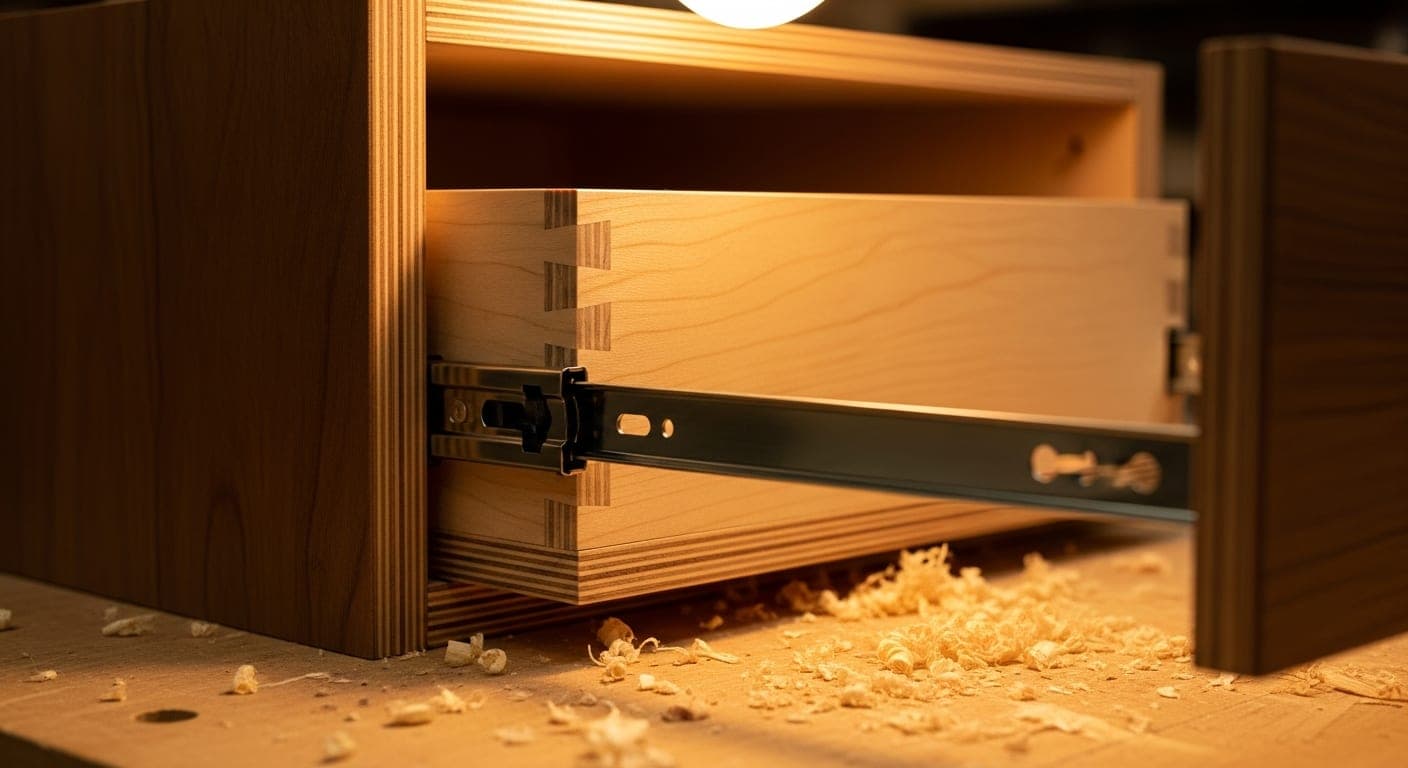
When comparing quotes, look beyond the total number and examine what is included. Fully custom quotes should itemize every component. Semi-custom quotes should clearly identify what is standard and what constitutes an upgrade. Pay particular attention to hardware: soft-close, full-extension hardware should be standard in any quality kitchen, not an upcharge.
It is also worth considering the long-term cost equation. Custom cabinetry built with premium materials and precision joinery typically lasts 25 years or more with minimal maintenance. The annualized cost of a $30,000 custom kitchen over 25 years is $1,200 per year. A $15,000 semi-custom kitchen that needs replacement after 15 years costs $1,000 per year but delivers fewer years of satisfaction and requires the disruption of a second renovation.
When to Choose Each Option
Semi-custom may be the right choice if:
- Your kitchen has a relatively standard layout with square walls and consistent ceiling heights.
- You are satisfied with the door styles, finishes, and materials available in a semi-custom catalogue.
- Your budget is moderate and you want good quality without the investment of full custom.
- You are renovating a home you plan to sell within five to ten years and want to improve its appeal without maximizing every detail.
Fully custom is the right choice if:
- Your kitchen has non-standard dimensions, angled walls, unusual ceiling heights, or other architectural features that standard sizes cannot accommodate.
- You want specific materials, finishes, or door styles that are not available in semi-custom lines.
- You are renovating a condo where precise dimensions and building requirements demand tailored solutions.
- Storage optimization is a priority and you want every cabinet designed for specific contents and uses.
- You plan to stay in your home long-term and want a kitchen built to your exact specifications.
- The kitchen is a focal point of your home and you want a result that is indistinguishable from fine furniture.
The Deciding Question
Ask yourself this: are you willing to adapt your expectations to fit a product catalogue, or do you want the product built to fit your expectations? If the former, semi-custom is a practical choice. If the latter, fully custom is the way to go.
Most homeowners who invest in a fully custom kitchen report that the additional cost was justified by the daily experience of using a space designed specifically for them. The fit is better, the details are finer, and the sense of ownership is stronger when every element was chosen deliberately rather than selected from a limited menu.
How to Decide: A Practical Checklist
If you are still weighing the decision between semi-custom and fully custom, working through a set of specific questions about your space and your goals can bring clarity. Consider each of the following honestly, and let your answers guide you toward the right choice.
Is my kitchen a standard rectangle with square walls and a consistent ceiling height? If yes, semi-custom cabinets may accommodate your space without significant compromise. If your kitchen has angled walls, alcoves, soffits, varying ceiling heights, or other architectural irregularities - as many Toronto homes do - fully custom cabinetry will deliver a cleaner, more professional result by building to the exact conditions of your space rather than working around them.
Do I need cabinets in non-standard sizes? Measure the spaces where cabinets will go. If every opening falls neatly into three-inch increments, semi-custom may work. If you have an 11-inch gap beside the refrigerator or a 17-inch space between the window and the wall, custom cabinets fill those spaces completely rather than relying on filler strips that waste storage and compromise the appearance.
Do I want a specific wood species or finish that is not available in a catalogue? Semi-custom manufacturers offer a curated selection of materials and colours. If you have your heart set on zebrano accents, a particular shade of sage green matched to your living room, or a precise cabinet-grade matte finish, fully custom is the path that accommodates these preferences. At Apico, we work with exotic woods including zebrano, walnut, and cherry, and our finishing systems can match virtually any colour you specify.
Is maximizing every inch of storage important to me? In compact Toronto kitchens and condos, wasted space is a real cost. Custom cabinetry allows every cabinet to be designed for specific contents - a pull-out spice rack sized to the exact gap beside the stove, deep drawers configured for pots and pans, or a full-height pantry built to the precise ceiling height of your kitchen. If storage efficiency is a priority, custom construction is the approach that delivers it.
Am I staying in this home long-term? If you plan to sell within a few years, a well-executed semi-custom kitchen may provide the value improvement you need at a lower investment. If this is your long-term home, a fully custom kitchen built with quality materials, Blum soft-close hardware, and a durable finish system is an investment in daily satisfaction that pays dividends over decades of use. The annualized cost of a custom kitchen that lasts 25 or more years is often comparable to a semi-custom kitchen that needs replacement sooner.
Considering a custom kitchen for your Toronto home? Get a free quote and explore the full range of possibilities with custom cabinetry designed and built to your exact specifications.