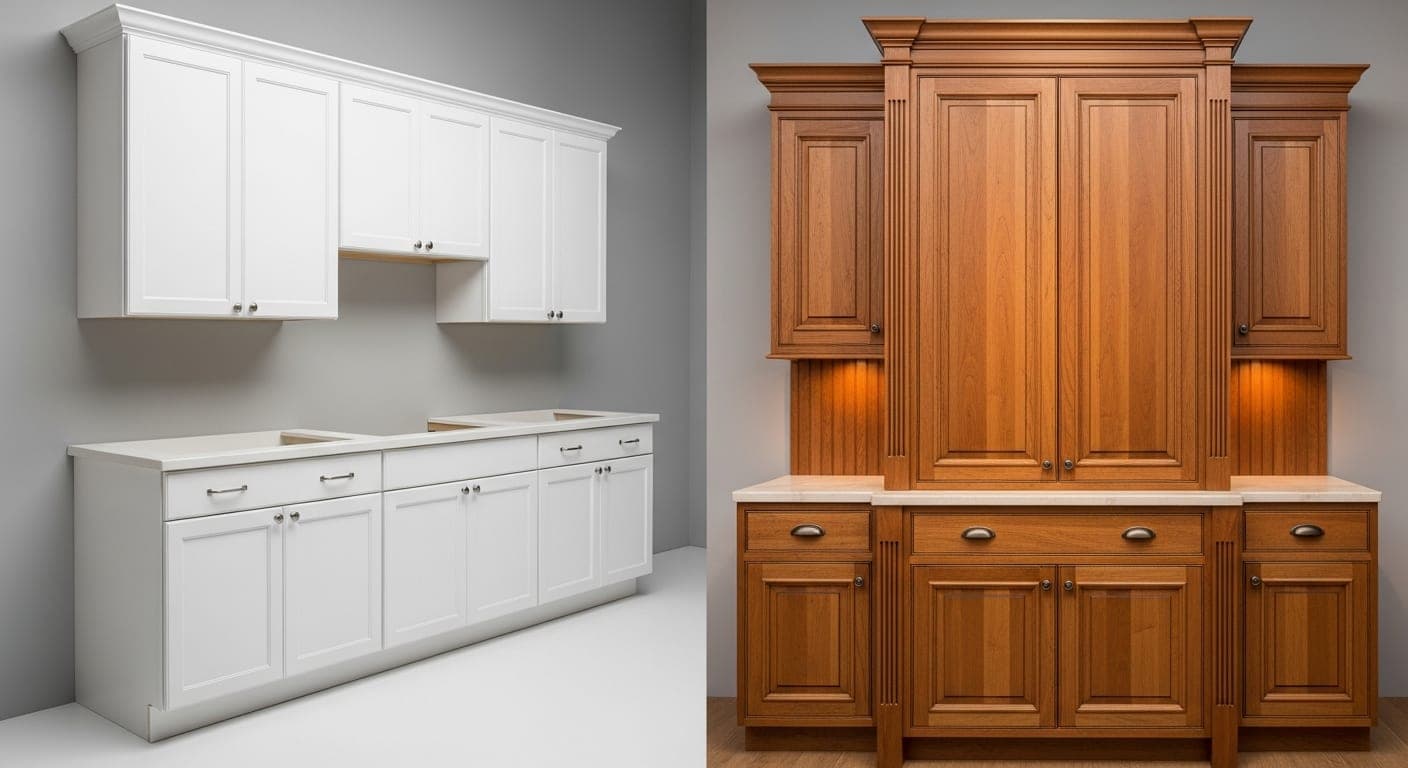
Choosing kitchen cabinets is one of the most consequential decisions in any renovation. Cabinets account for roughly 40 to 50 percent of a typical kitchen budget, and they define the look, function, and longevity of the space. Toronto homeowners generally have three options: stock cabinets, semi-custom cabinets, and fully custom cabinetry. Each sits at a different point on the spectrum of cost, quality, and flexibility.
This guide breaks down all three categories so you can make an informed decision based on your space, your budget, and the way you actually use your kitchen.
What Are Stock Kitchen Cabinets?
Stock cabinets are pre-manufactured units produced in standardized sizes and finishes. They are built on assembly lines in large volumes, warehoused, and shipped to retailers or big-box stores for immediate sale. Because they are mass-produced, they offer the lowest price point of the three categories.
Stock cabinets come in fixed width increments, usually three-inch or even five-inch intervals. This leads to the 'Filler Strip' Issue: if your wall doesn't perfectly match their increments, you are forced to use 8-inch filler strips to bridge the gaps. This is not just an aesthetic flaw; it is a waste of prime kitchen real estate. At Apico, we use 2-inch increments to virtually eliminate waste and maximize every square inch.
However, they also suffer from what we call the 'Flat-Pack Compromise'. To make shipping across oceans cost-effective, these units often rely on weak cam-lock connectors and thin substrates. In contrast, local builds are screwed and joined for structural density. Furthermore, imported units are often lighter and less dense specifically to save on freight costs, whereas local Toronto manufacturing utilizes high-density plywood and MDF built to last decades.
There are situations where stock cabinets make sense. If you are renovating a rental property, staging a home for sale, or working within an extremely tight budget, the speed and low cost of stock cabinets can be appealing. They can be in your hands within days.
However, the trade-offs are significant. Because sizes are fixed, filler strips are needed wherever a cabinet does not align with your walls. In older Toronto homes, where walls are rarely perfectly square, this can mean visible gaps and wasted space. Hardware is typically basic, with partial-extension drawer slides and no soft-close mechanism unless you pay for upgrades.
What Are Semi-Custom Kitchen Cabinets?
Semi-custom cabinets occupy the middle ground. Like stock cabinets, they start from a catalogue of standard sizes and door styles. Unlike stock cabinets, they allow some degree of modification. You can usually adjust cabinet depth, choose from a broader range of finishes, and add features like pull-out trays, lazy Susans, or specialized drawer inserts.
Semi-custom lines often use better construction than stock: plywood box construction is common, and hardware tends to be more durable. Lead times range from four to eight weeks, depending on the manufacturer and the modifications requested.
The limitation of semi-custom is that modifications work within the manufacturer's predefined framework. You can adjust dimensions within a range, but you cannot specify a cabinet of any arbitrary size. Door styles are limited to what the manufacturer offers. If your kitchen has an unusual layout, angled walls, or non-standard ceiling heights, semi-custom cabinets may still require compromises.
For many Toronto homeowners, semi-custom represents a reasonable balance between cost and customization, particularly for kitchens with relatively standard dimensions.
What Are Fully Custom Kitchen Cabinets?
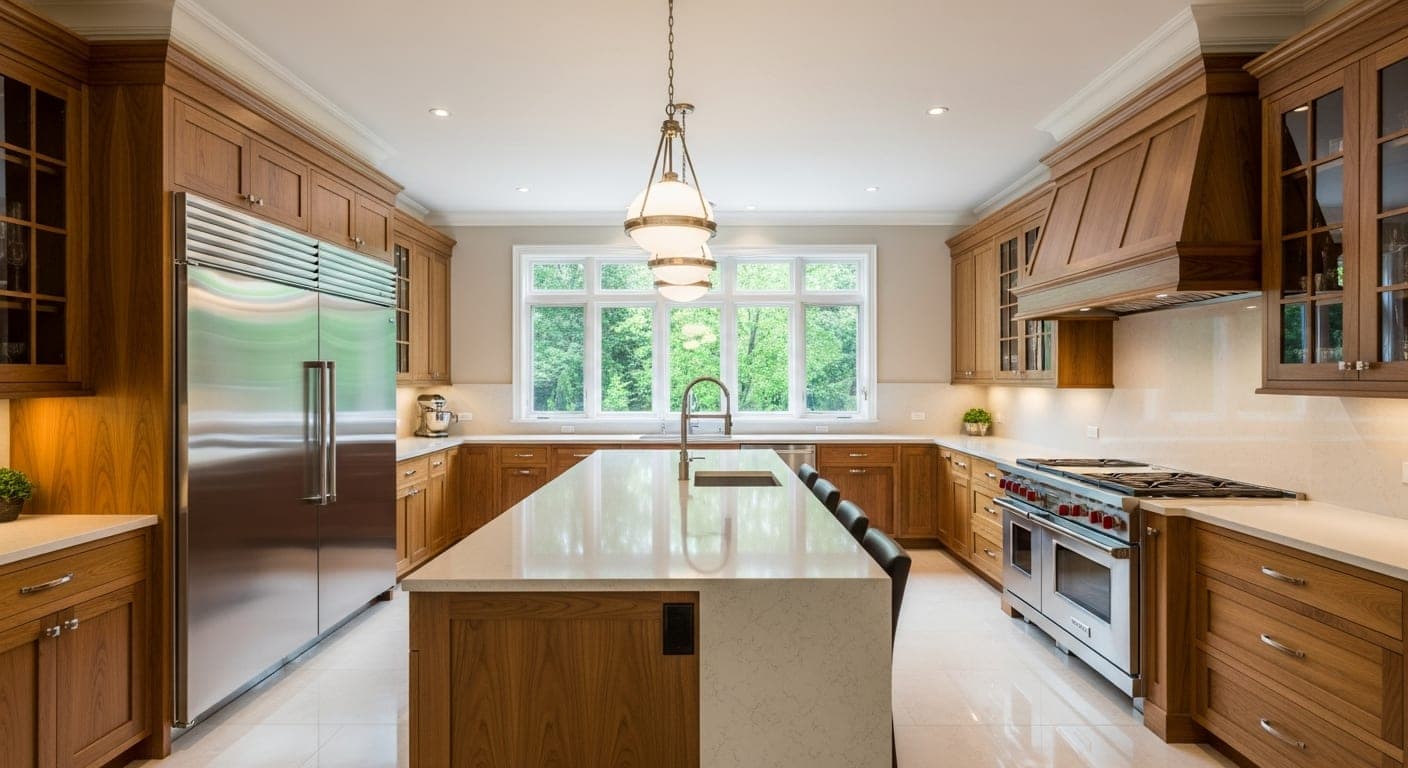
Fully custom cabinetry is built from scratch to the exact specifications of your kitchen. Every cabinet is designed individually, accounting for the precise measurements of your space, your storage needs, your aesthetic preferences, and any architectural constraints.
With custom cabinets, there are no size limitations. A cabinet can be built to any width, height, or depth. This is particularly valuable in Toronto, where housing stock ranges from century homes with plaster walls and uneven floors to modern condos with unusual floor plans and strict building regulations.
One factor many homeowners overlook is the Toronto Humidity Factor. Our local climate causes significant expansion and contraction of wood. To combat this, Apico uses high-grade flexible paint systems designed to move with the wood, preventing the 'hairline joint cracking' that often appears in February when the furnace is running at full tilt. For those particularly concerned about joint movement, we often recommend staining as a pro-move to avoid these issues entirely.
Custom cabinet makers can work with a wide range of materials, from traditional hardwoods like maple and cherry to exotic species such as walnut and zebrano. Finishes are unlimited: premium paint systems, hand-applied stains, glazes, high-gloss lacquer, or natural wood finishes. Hardware can include full-extension, soft-close drawer slides and hinges as standard, with options for electric auto-open mechanisms.
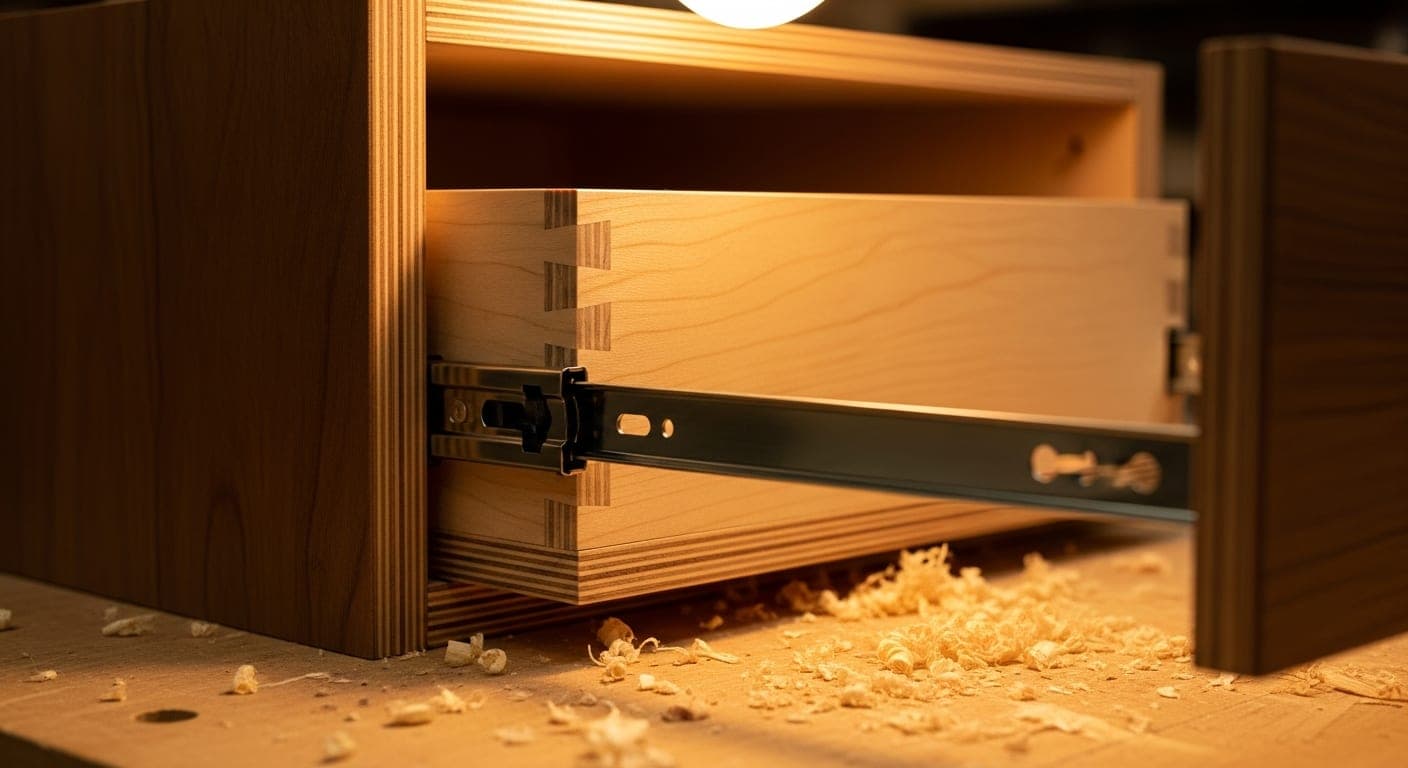
Construction methods in custom cabinetry are typically superior. Frameless (European-style) construction maximizes interior space. Boxes are built from plywood rather than particleboard, resulting in cabinets that resist moisture and hold fasteners more securely over time.
For a deeper comparison, see our guide to semi-custom vs. fully custom kitchens.
The primary consideration with custom kitchens is cost and lead time. Custom cabinets require a design process, on-site measurements, and a manufacturing period. The investment is higher than stock or semi-custom, but the result is a kitchen built precisely for your home.
Cost Comparison
Understanding the cost differences between these three options helps set realistic expectations.
Stock cabinets for an average Toronto kitchen typically range from $3,000 to $8,000 for the cabinetry alone. Installation, countertops, and hardware are additional. The low price reflects standardized manufacturing and basic materials.
Semi-custom cabinets generally fall between $8,000 and $25,000, depending on the extent of modifications, materials selected, and the manufacturer. This range covers better construction, more finish options, and improved hardware.
Fully custom cabinets for a Toronto kitchen range from approximately $7,000 to $70,000 or more. The wide range reflects the vast differences in scope: a compact condo kitchen with straightforward cabinetry sits at the lower end, while a large home with premium materials, complex layouts, and high-end hardware occupies the upper end.
It is worth noting that the cost-per-year calculation often favours custom cabinetry. Stock cabinets may need replacement within 10 to 15 years, while well-built custom cabinets can last 25 years or longer. When evaluated over the life of the product, the annual cost of ownership can be comparable or even lower.
Which Is Right for Your Toronto Home?
The right choice depends on several factors specific to your situation.
Consider stock cabinets if:
- You are working with a very limited budget and need a functional kitchen quickly.
- The space is a rental property or a home you plan to sell within a few years.
- Your kitchen has standard dimensions with square walls and level floors.
Consider semi-custom cabinets if:
- You want better quality and more design options than stock but do not need fully bespoke sizing.
- Your kitchen layout is relatively conventional.
- You are comfortable choosing from a catalogue of styles and finishes.
Consider fully custom cabinets if:
- Your kitchen has non-standard dimensions, angled walls, unusual ceiling heights, or other architectural features.
- You want specific materials, finishes, or hardware that are not available in stock or semi-custom lines.
- You are renovating a condo with building restrictions that require precise coordination.
- You view your kitchen as a long-term investment and want cabinetry that will last decades.
- Storage optimization is a priority, and you want every inch of space used efficiently.
Toronto's diverse housing stock often pushes homeowners toward custom solutions. Victorian semi-detached homes, post-war bungalows, and modern high-rise condos each present unique spatial challenges. In many cases, the dimensional flexibility of custom cabinetry is not a luxury but a practical necessity for achieving a clean, professional result.
A Note on Lead Times
Stock cabinets can be available immediately. Semi-custom typically requires four to eight weeks. Fully custom kitchens generally take six to eight weeks from design approval to installation. If your timeline is flexible, the additional wait for custom cabinetry is modest relative to the improvement in quality and fit.
Making Your Decision
The best approach is to get informed before committing. Visit showrooms, request material samples, and ask detailed questions about construction methods, hardware, and warranties. A reputable cabinet maker will welcome these questions and provide transparent answers.
If you are considering custom cabinetry for your Toronto kitchen, a consultation with an experienced manufacturer can clarify what is achievable within your budget and timeline. Many homeowners are surprised to find that custom is more accessible than they assumed, particularly when they factor in the long-term value proposition.
Questions to Ask Before You Choose
Regardless of which category you are leaning toward, asking the right questions before you commit will protect your investment and ensure you understand exactly what you are purchasing. Here are the questions every homeowner should bring to a cabinet consultation.
What material is the cabinet box made from? This is perhaps the most important question, and it is the one most often overlooked. The box is the structural foundation of every cabinet. Plywood boxes offer superior screw retention, moisture resistance, and long-term durability compared to particleboard. If the answer is vague - "wood composite" or "engineered wood" - press for specifics. At Apico, our cabinet boxes are constructed from plywood and high-grade MDF, chosen strategically based on the application.
What hardware brand do you use? Hardware is what you interact with every time you open a door or pull out a drawer. Cheap hardware fails within a few years, resulting in sagging doors and sticky drawers. Ask whether soft-close hinges and full-extension drawer slides are standard or an upgrade. Apico installs European hinges and Blum hardware as standard on every project, with auto-open mechanisms available for handle-free designs.
What is your finish system? Not all paint is the same. A cabinet finished with consumer-grade paint will chip, yellow, and wear far sooner than one finished with an industrial system. Ask whether finishes are applied in a controlled spray booth and what product line is used. Apico uses professional cabinet-grade coating systems, delivering a finish with exceptional depth, colour accuracy, and resistance to wear.
Do you build to custom dimensions? If the answer is no, or if modifications are limited to predefined increments, you are looking at semi-custom rather than fully custom. In Toronto homes, where walls are rarely square and ceiling heights vary, the ability to build a cabinet to any dimension is the difference between a seamless result and one filled with filler strips and compromises.
What warranty do you offer? A warranty reveals how confident a manufacturer is in their product. Look for a lifetime warranty on hardware and a multi-year warranty on finishes. Apico provides a lifetime hardware warranty and a five-year finish warranty, reflecting the quality of materials and craftsmanship in every project.
Can I see samples in my home? Colours, materials, and finishes look different under showroom lighting than they do in your kitchen. A manufacturer willing to bring a mobile showroom to your home demonstrates both confidence in their product and a commitment to helping you make the right choices. Apico's mobile showroom brings door styles, wood species, finish samples, and hardware directly to your kitchen, so you can evaluate everything in the lighting conditions where you will live with your decision.
Ready to explore what custom cabinetry can do for your kitchen? Get a free quote or learn more about our custom kitchen design and manufacturing process.