The materials used in your cabinetry affect everything: the look and feel of the finished kitchen, the durability of the cabinets over decades of use, how they respond to moisture and temperature changes, and ultimately, their cost. Understanding your material options allows you to make choices that align with your aesthetic goals, your functional requirements, and your budget.
This guide covers the most common materials used in custom cabinetry in Toronto, from solid woods and engineered panels to finishes and coatings.
Solid Wood Options
Solid hardwood remains the premium choice for cabinet doors and drawer fronts. Each species has distinct grain patterns, colour characteristics, and working properties that make it suited to particular design styles.
Maple
Maple is the workhorse of Canadian cabinetry. It is a dense, fine-grained hardwood that machines cleanly and takes paint and stain exceptionally well. Its tight, consistent grain makes it the preferred choice for painted cabinet doors, where the smooth surface produces a flawless finish without visible grain patterns telegraphing through the paint.
Hard maple is abundantly available in Canada, which helps keep material costs reasonable. It is extremely durable, resisting dents and wear better than softer hardwoods. For homeowners who want a classic look with longevity, maple is difficult to beat.
Walnut
Walnut is prized for its rich, dark chocolate-brown colour and dramatic grain patterns. It is a statement material that brings warmth and sophistication to a kitchen. Walnut is often used for feature elements such as islands, open shelving, or accent panels rather than for every cabinet in the room.
The wood darkens subtly over time with light exposure, deepening its natural colour. It is softer than maple, which means it can show wear more quickly in high-traffic areas. Most designers recommend a clear finish or a light oil to let walnut's natural beauty speak for itself rather than staining it.
Walnut commands a premium over domestic species like maple and birch. Its visual impact and the sense of luxury it conveys make it a popular choice for high-end Toronto kitchens.
Cherry
Cherry is a medium-toned hardwood with a warm, reddish-brown hue that deepens dramatically over time. A newly installed cherry kitchen will noticeably darken over the first year, eventually reaching a deep, rich patina. This natural aging process is considered one of cherry's most appealing characteristics.
Cherry has a smooth, close grain that finishes beautifully with minimal effort. It is well-suited to traditional and transitional kitchen designs. Homeowners should be aware of the colour change and embrace it as part of the material's character rather than trying to prevent it.
Exotic Woods (Zebrano)
For homeowners seeking something truly distinctive, exotic wood species offer visual characteristics unavailable in domestic hardwoods. Zebrano, also known as zebrawood, features bold, dark streaks against a lighter background, creating a striped pattern that is immediately eye-catching.
Exotic woods are typically used selectively rather than for an entire kitchen. A zebrano island, a set of accent panels, or a feature wall of cabinetry can serve as the centrepiece of the room while more restrained materials handle the perimeter.
The cost of exotic species is higher, and availability can be less predictable than domestic woods. Working with a cabinet maker experienced in exotic materials ensures proper handling, finishing, and joinery techniques suited to each species.
MDF vs. Plywood -- What's Inside Your Cabinets
While doors and drawer fronts receive the most visual attention, the cabinet boxes themselves are the structural foundation of your kitchen. Two primary materials are used for cabinet box construction: plywood and MDF.
Plywood is made from thin layers of wood veneer glued together with alternating grain directions. This cross-laminated construction gives plywood excellent strength, rigidity, and resistance to warping. It holds screws securely, resists moisture better than particleboard, and can handle the weight of heavy items stored inside cabinets. Plywood is the preferred box material for quality custom cabinetry. It is important to note that Material Density varies significantly: imported units are often lighter and less dense to save on ocean freight costs, whereas local builds use much higher-density plywood and MDF for long-term structural integrity.
MDF (Medium Density Fibreboard) is an engineered panel made from wood fibres bonded with resin under heat and pressure. It has a perfectly smooth, uniform surface with no visible grain, which makes it the ideal substrate for painted doors. In Toronto's climate, MDF is particularly useful as it is more stable than solid wood during seasonal humidity shifts. However, for those concerned about expansion and contraction, we often recommend staining as a pro-tip: it is a great way to avoid the 'hairline joint-cracking' issues that can occasionally affect painted wood joints during the dry February furnace season.
In practice, many custom cabinet makers use both materials strategically. Plywood is used for cabinet boxes, shelves, and drawer boxes where structural integrity and moisture resistance are priorities. MDF is used for painted door fronts where its smooth surface produces a superior finish.
Some manufacturers use particleboard for cabinet boxes to reduce costs. Particleboard is made from wood particles bonded with resin and is the weakest and most moisture-susceptible of the common panel materials. It is standard in stock cabinets but generally avoided in quality custom work. If you are evaluating quotes, ask specifically what material is used for cabinet boxes and be cautious of vague descriptions like "wood composite."
Laminates and Thermofoil
Laminate and thermofoil are surface materials applied over an MDF or particleboard substrate. They offer a wide range of colours and patterns at a lower cost than solid wood or painted finishes.
High-pressure laminate (HPL) is a durable surface material bonded to a substrate under high heat and pressure. Modern laminates are available in textures that convincingly mimic wood grain, stone, and other natural materials. They are resistant to staining, easy to clean, and relatively affordable. The edges of laminate doors require careful treatment, typically with matching edge banding, to prevent moisture intrusion.
Thermofoil is a vinyl film vacuum-formed over an MDF substrate. It produces a seamless, wrapped surface with no visible edge joints. Thermofoil is available in many colours and can replicate raised panel and shaker profiles. It is an economical option for achieving a uniform, easy-to-maintain surface.
The primary limitation of thermofoil is its vulnerability to heat and adhesive failure over time. Cabinets directly adjacent to ovens or toasters can experience peeling. Quality thermofoil products from reputable manufacturers resist this better than economy options, but the risk remains higher than with painted or solid wood surfaces.
Lacquer and Paint Finishes
The finish applied to your cabinets is as important as the underlying material. It determines the colour, sheen, durability, and maintenance requirements of your kitchen.
Stain finishes penetrate the wood surface, allowing the natural grain to remain visible while adding colour. Stains range from light, natural tones to deep, rich hues. They are typically sealed with a clear topcoat of lacquer or conversion varnish to provide durability and moisture resistance. Stained finishes are the choice for homeowners who want to showcase the character of natural wood.
Paint finishes cover the wood or MDF surface completely with an opaque colour coat. The quality of a painted finish depends heavily on the preparation, application method, and product used.
Professional Paint Systems
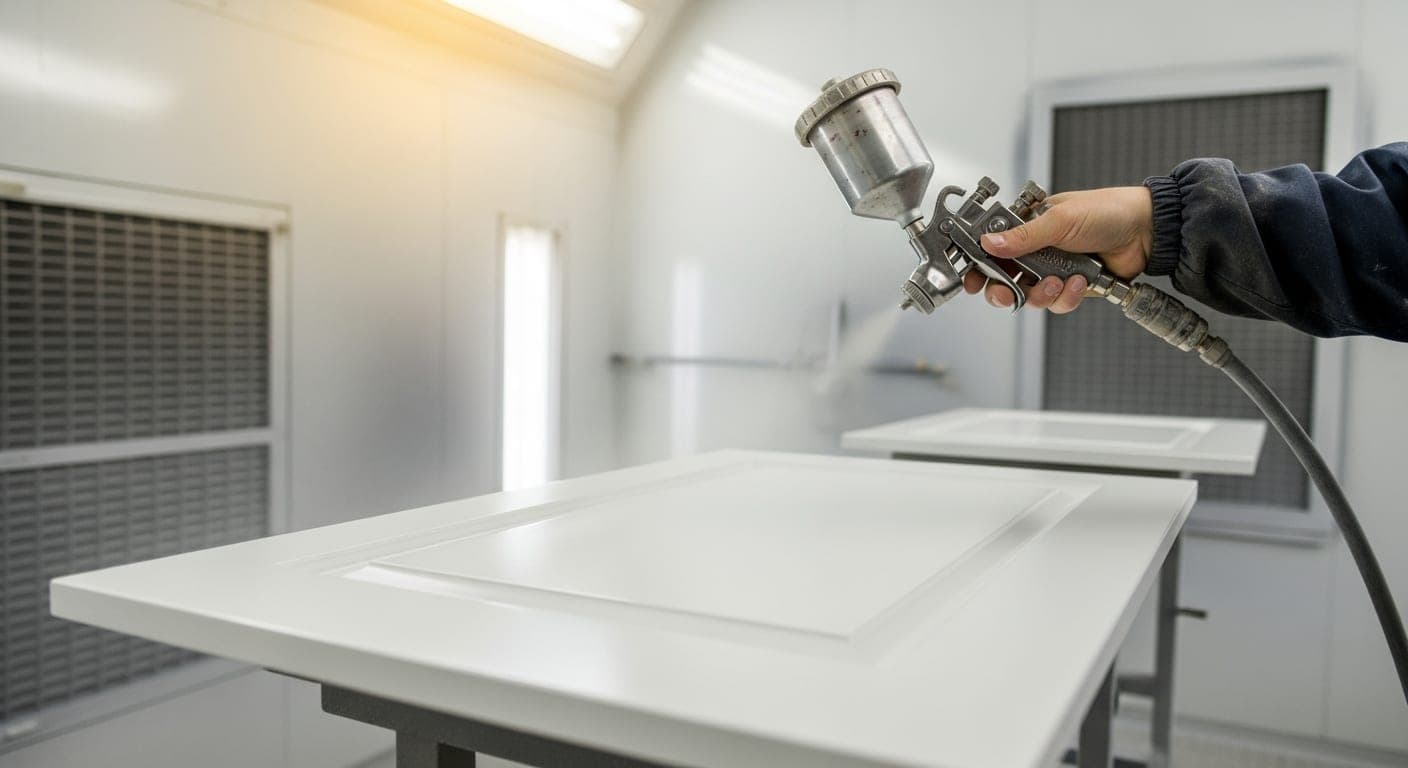
Not all paint is created equal. Industrial paint systems designed for cabinetry use deliver a level of finish quality that consumer-grade paints cannot match. These systems involve multiple steps: a sealer coat, a primer coat, and multiple colour coats, each sanded between applications and applied in a controlled spray booth environment.
Professional cabinet-grade coatings are formulated for adhesion, durability, and colour stability. They resist chipping, scratching, and yellowing over time. The finish has a depth and smoothness that depends on both the coating system and the controlled spray process.
For homeowners choosing a painted kitchen, the quality of the paint system should be a key factor in evaluating quotes. A beautiful colour applied with an inferior product will disappoint within a few years. A quality paint system applied properly will look as good in year ten as it did on installation day.
Glaze finishes add dimension and visual interest by applying a semi-transparent colour over a base coat, then wiping it to leave colour in the recesses of the door profile. Glazing highlights the architectural details of a door style and creates an aged, layered appearance popular in traditional and country-style kitchens.
Choosing the Right Material for Your Project
Material selection should be guided by your design goals, your lifestyle, and your budget. Here are some practical guidelines.
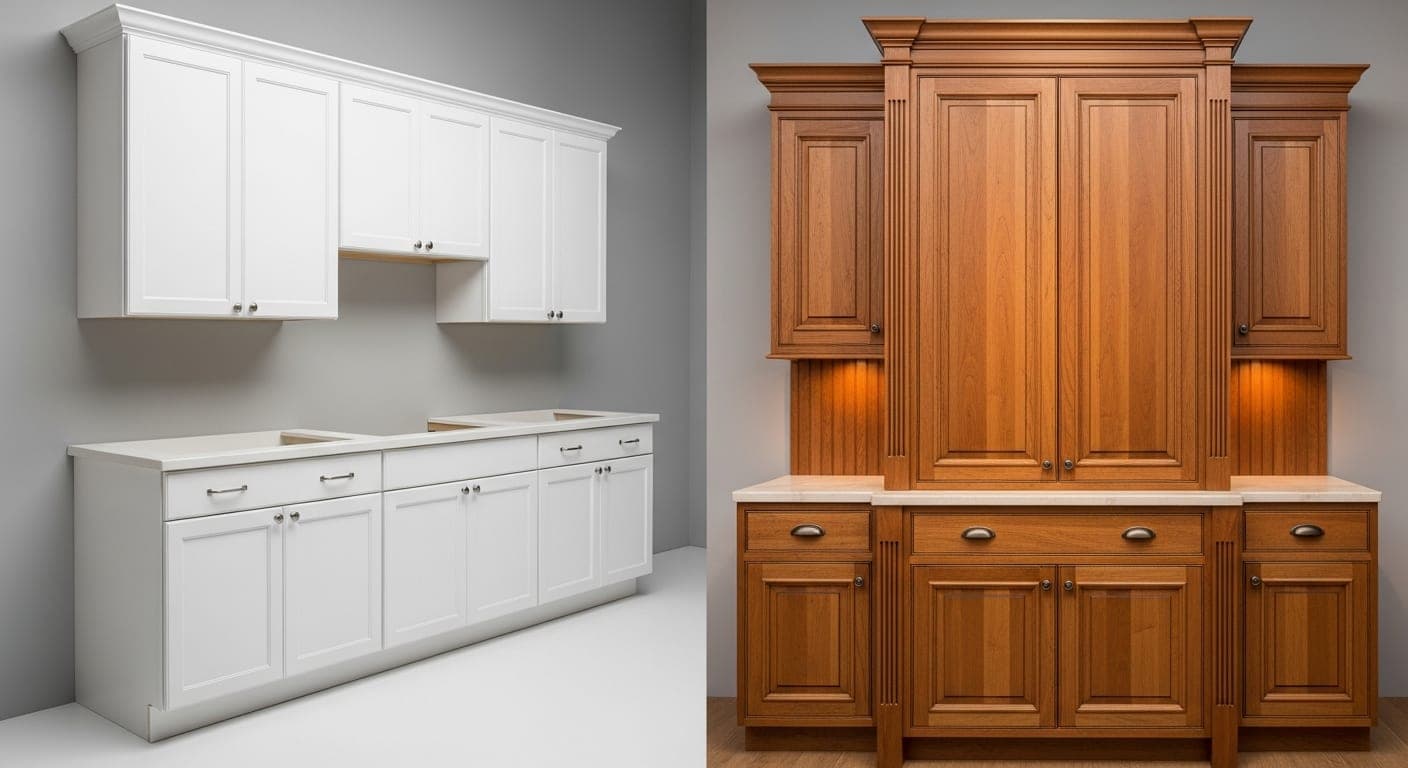
For a modern, clean-lined kitchen: Painted MDF doors with a quality lacquer or professional coating system, combined with plywood box construction. Flat panel or thin shaker door profiles maintain the contemporary aesthetic.
For a warm, traditional kitchen: Solid maple or cherry doors with stain and clear coat finishes. The natural wood grain adds warmth and character. Plywood boxes ensure long-term structural integrity.
For a statement kitchen: Walnut or exotic wood accents paired with a complementary painted or stained perimeter. This approach creates visual interest while managing material costs.
For a budget-conscious renovation: Thermofoil or laminate doors with plywood box construction. This combination delivers an attractive, durable kitchen at a lower price point while maintaining quality where it matters most, in the cabinet box.
Regardless of the materials you choose, construction quality and hardware are equally important. A maple door means little if it is hung on a cheap hinge that fails after two years. Soft-close, full-extension hardware with a lifetime warranty should be considered non-negotiable in any kitchen expected to perform for decades.
One of the most effective ways to make confident material decisions is to evaluate samples in the environment where they will be installed. Showroom lighting rarely matches the conditions in your home, and a finish that looks perfect under commercial LEDs can appear surprisingly different in your kitchen's natural light. Apico's mobile showroom addresses this directly by bringing wood samples, painted door fronts, hardware, and finish options to your home, allowing you to compare materials side by side against your existing flooring, countertops, and wall colours in the lighting you live with every day.
Exploring materials for your custom cabinetry project? Request a free consultation to see and touch material samples and discuss which options suit your kitchen, your lifestyle, and your budget.