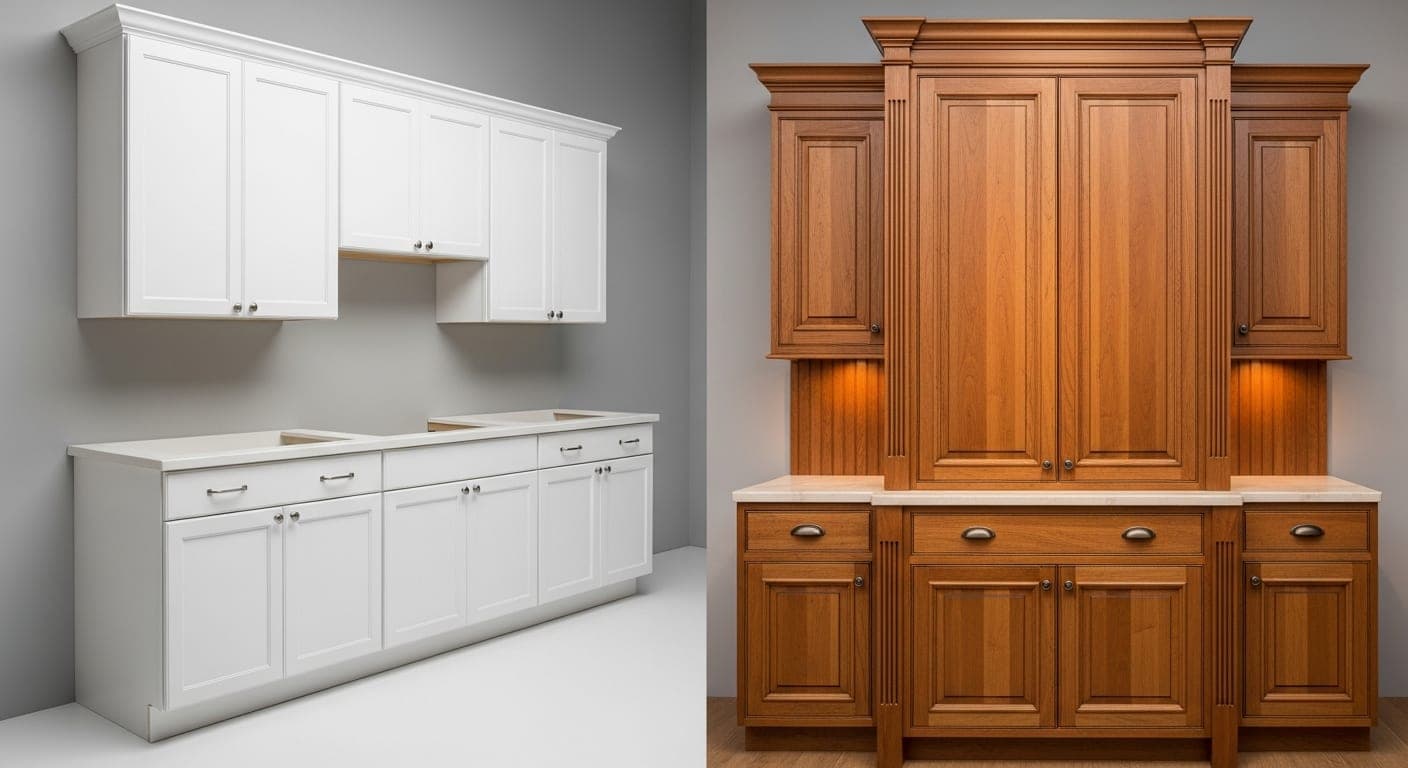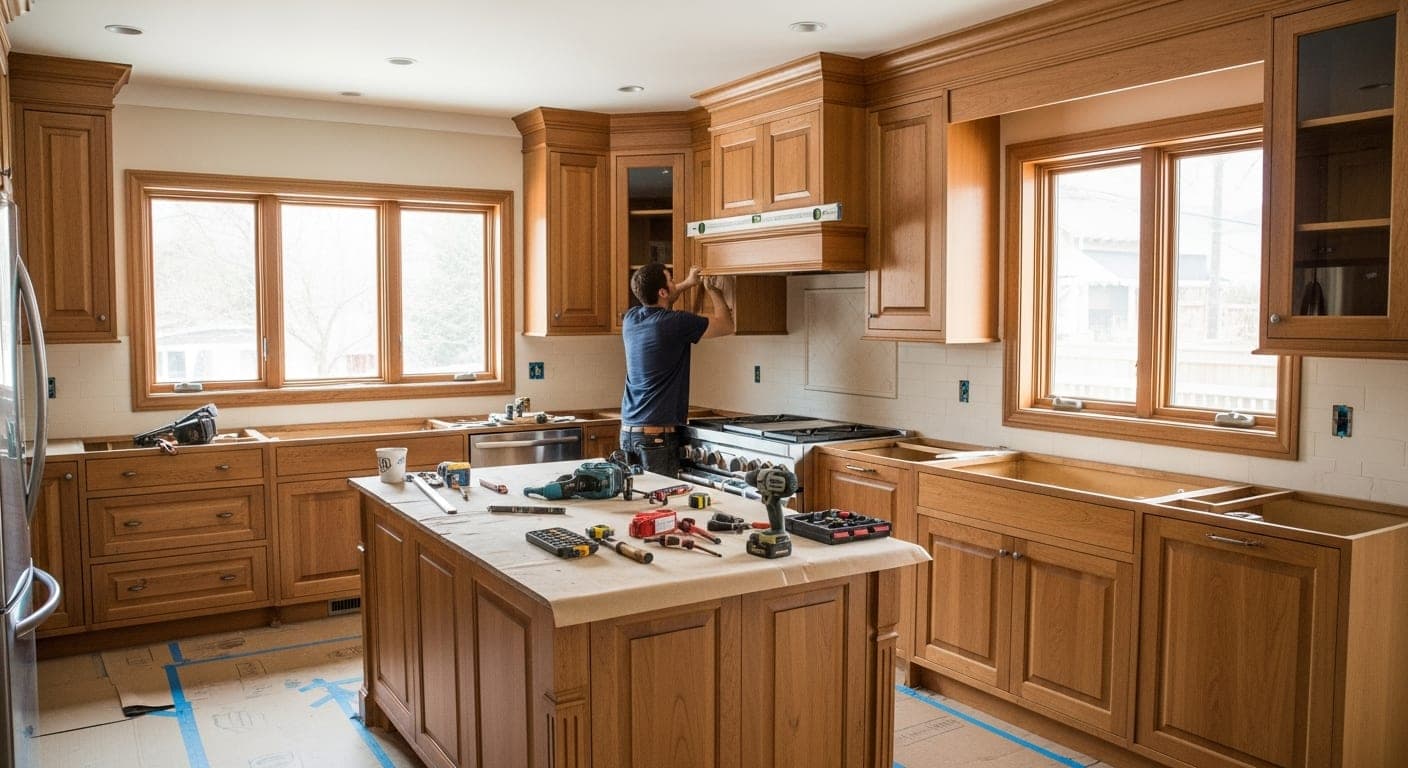
Where your kitchen cabinets are manufactured affects their quality, their lead time, the service you receive, and the broader economic impact of your purchase. In a market where "custom" and "Canadian-made" are sometimes used loosely, understanding the difference between locally manufactured cabinetry and imported products helps you make a more informed decision.
Where Do Most Cabinets Come From?
The Canadian cabinet market includes products from a range of origins. At one end, large-scale stock cabinet manufacturers produce millions of units in overseas factories, primarily in China and Southeast Asia, for distribution through big-box retailers and kitchen dealers. At the other end, Canadian manufacturers build cabinets in local factories using domestic and imported raw materials.
Between these extremes is a grey area. Some companies import partially assembled cabinets or components from overseas and finish or assemble them in Canada. Others import fully finished cabinets and rebrand them with Canadian-sounding company names. The term "Canadian company" does not always mean "Canadian-made product."
Understanding where your cabinets are actually built, not just where the company is headquartered, is essential for evaluating quality, turnaround time, and warranty reliability.
The Benefits of Canadian-Made Cabinetry
Quality Control
When cabinets are manufactured in a local factory, quality control is direct and continuous. The company's management, design team, and production staff work under one roof. Issues are identified and corrected immediately during production rather than discovered after a container arrives from overseas.
A Toronto-based factory operates under Canadian workplace and environmental regulations, which influence material choices and finishing processes. Materials sourced for Canadian manufacturing are selected for performance in local climate conditions, where homes experience significant humidity fluctuations between summer and winter.
Local manufacturing also means the people building your cabinets understand the conditions they will be installed in. They know that Toronto homes expand and contract seasonally, that condo environments differ from single-family homes, and that the materials and construction methods must account for these realities.
Faster Turnaround
Imported cabinets typically require eight to sixteen weeks for production and shipping, plus customs clearance and domestic transportation. Delays are common due to shipping disruptions, port congestion, container shortages, and customs holds. These delays are largely outside anyone's control and can push a renovation timeline back by weeks or months.
Canadian-made custom cabinetry manufactured in Ontario has a typical turnaround of six to eight weeks from design approval to delivery. Because the workshop is local to the region, there is no ocean freight, no customs clearance, and no cross-border logistics to manage. If an issue arises during production, it can be addressed quickly rather than requiring weeks of back-and-forth communication across time zones.
For Toronto homeowners managing a renovation timeline that involves coordinating multiple trades, predictable delivery dates are valuable. A two-week shipping delay on cabinets can cascade through the entire project, postponing countertop templating, appliance installation, plumbing hookups, and everything that follows.
Supporting Local Industry
Purchasing Canadian-made cabinetry supports local employment, local supply chains, and the Canadian manufacturing sector. Factory workers, designers, delivery crews, and installation teams all work and live in the communities they serve. Material suppliers, hardware distributors, and finish manufacturers who supply local cabinet shops also benefit.
This is not a minor consideration. The Canadian manufacturing sector has faced decades of pressure from lower-cost imports. Every dollar spent on locally made products contributes to the viability of skilled trades and manufacturing jobs in Ontario.
The Hidden Costs of Imported Cabinets
The sticker price on imported cabinets can be appealing, but it rarely tells the full story.
Shipping and logistics. The cost of ocean freight, customs duties, brokerage fees, and domestic transportation adds to the landed cost of imported cabinets. These costs are sometimes absorbed into the retail price and sometimes added as separate line items. Either way, the homeowner pays.
Damage and deficiency. Cabinets that travel in shipping containers across oceans are subject to handling damage, moisture exposure, and temperature extremes. This often leads to a 'Replacement Nightmare': a single missing or damaged panel from an import can take months to arrive. In contrast, local Toronto manufacturing allows for 'running changes' and replacements in just a few days.
Warranty limitations. A warranty from an overseas manufacturer can be difficult to enforce. If a finish fails or a structural component warps, who handles the claim? A local manufacturer with a factory in your city can inspect the issue, determine the cause, and produce a replacement quickly. An importer may need to coordinate with an overseas factory, subject to their production schedule and shipping timelines.
Material and safety standards. Canadian manufacturing is subject to regulations governing formaldehyde emissions, workplace safety, and environmental compliance. Imported products may or may not meet the same standards, and verification can be difficult. Particleboard manufactured overseas may use adhesive systems with higher emission levels than Canadian regulations permit.
Fit and precision. Imported cabinets are often built using the 'Flat-Pack Compromise' - they use weak cam-lock connectors to make shipping more efficient. Local builds, however, are screwed and joined for much higher structural density and longevity. Furthermore, imported units are often built with lower-density materials to save on freight weight, whereas Canadian-made cabinets use high-density substrates designed for the local climate.
How to Verify Canadian-Made Claims
Given the marketing advantages of the "Canadian-made" label, some companies use it loosely. Here are ways to verify the claim.
Review photos and process. A genuine Canadian manufacturer will be proud to share photos and videos of their production facility and explain their manufacturing process in detail. If a company cannot or will not share these details, that is a significant red flag.
Ask specific questions. Where is the factory located? What is the street address? How many people work there? What equipment do they use? Genuine manufacturers can answer these questions in detail. Companies that import and rebrand will often give vague or evasive responses.
Request a mobile showroom visit. Some Canadian manufacturers bring material samples, door styles, and hardware directly to your home using a mobile showroom. This demonstrates both confidence in their product and a commitment to customer service that importers rarely match. It also gives you an opportunity to ask questions about manufacturing in a comfortable setting.
Check industry memberships. Membership in organizations like the National Kitchen and Bath Association (NKBA) and the Building Industry and Land Development Association (BILD) indicates a commitment to professional standards. These memberships are not guarantees of manufacturing origin, but they are more common among legitimate local manufacturers than among importers.
Review warranties carefully. A strong warranty backed by a local manufacturer is fundamentally different from a warranty backed by an overseas factory. Look for specific commitments: lifetime warranty on hardware, multi-year warranty on finishes, and clear language about what is covered and how claims are handled.
Look at their track record. A Canadian manufacturer with decades of experience and hundreds or thousands of completed local projects has a verifiable history. Ask for references, review their portfolio, and read reviews from past clients on Google, Houzz, and HomeStars. A company that has been building cabinets in Toronto since the 1990s and has completed over a thousand GTA projects offers a level of accountability that a recently established import operation cannot match.
Learn more about us and our Canadian manufacturing approach to see what local production looks like in practice.
What Canadian-Made Means at Apico
The term "Canadian-made" can mean different things depending on who uses it. At Apico, it means every cabinet is designed, built, finished, and assembled in our Ontario workshop for Toronto and GTA homes. There is no overseas component manufacturing, no imported flat-pack assembly, and no ambiguity about where the work is done.
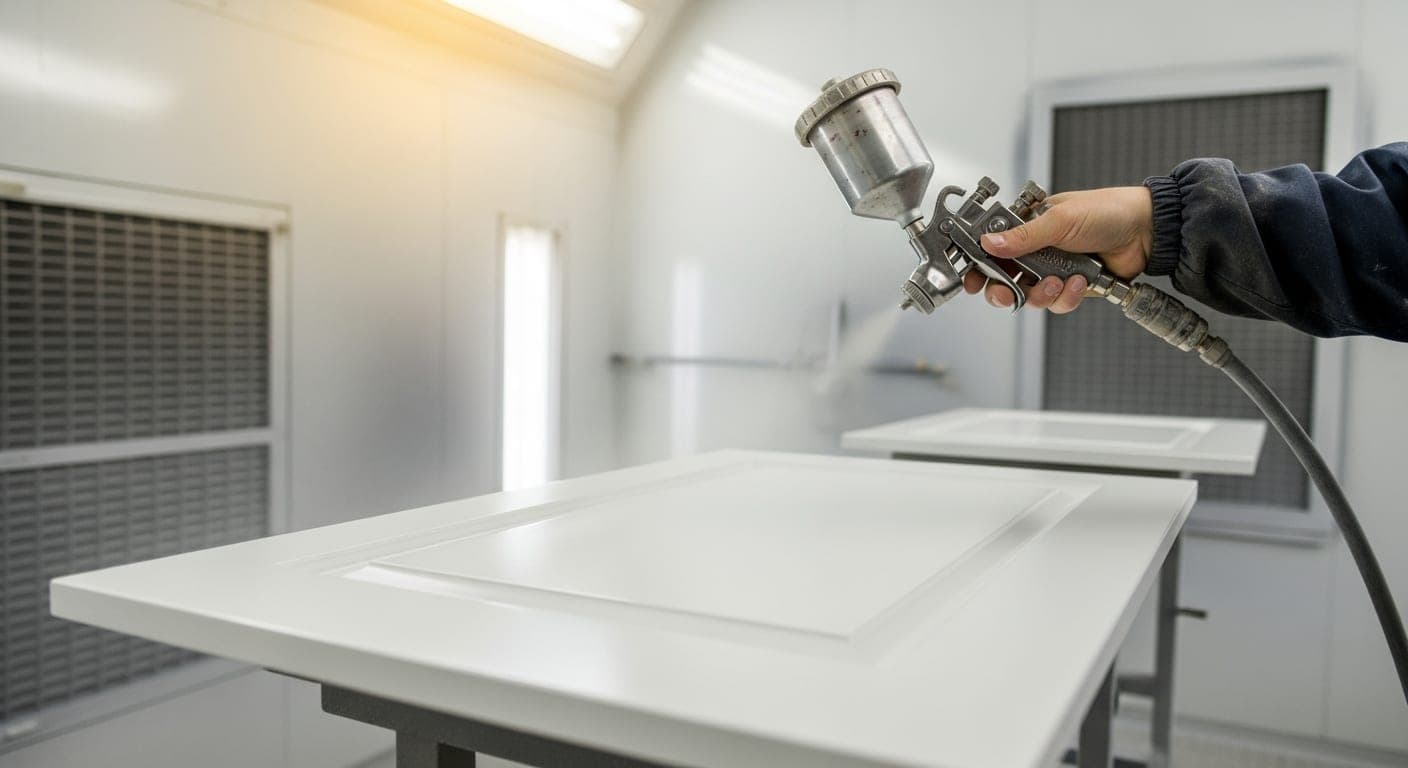
Our workshop is where raw sheet goods are cut on CNC machinery, where edge banding is applied, where cabinet boxes are assembled with precision joinery, and where doors are finished in a dedicated spray booth using professional cabinet-grade coating systems. The same facility houses our hardware installation, where European hinges and Blum soft-close mechanisms are fitted and tested on every door and drawer before the cabinets leave the building. This vertically integrated approach means that quality control is continuous - from the first cut to the final inspection, every step happens under one roof.
Because our workshop is local to the region, we maintain the ability to make adjustments during production. If you decide to change a cabinet dimension, swap a door style, or modify a finish colour after production has begun, we can accommodate that change quickly and without the weeks-long delays that come with overseas manufacturing. This flexibility is one of the practical advantages of genuine local production that homeowners rarely consider until they need it.
Our Ontario workshop and GTA service area also mean that our team is local and accountable. Knowing that your cabinets are built close to home provides a level of confidence that no brochure or website can replicate. Founded by Apic Imasdounian, Apico brings over 40 years of hands-on cabinetry experience to every kitchen, vanity, and wall unit we produce, and that experience is visible in our processes and our finished work.
Looking for Canadian-made custom cabinetry built in Ontario for a Toronto or GTA home? Request a free consultation to see our materials and discuss your project with the people who will build your cabinets.