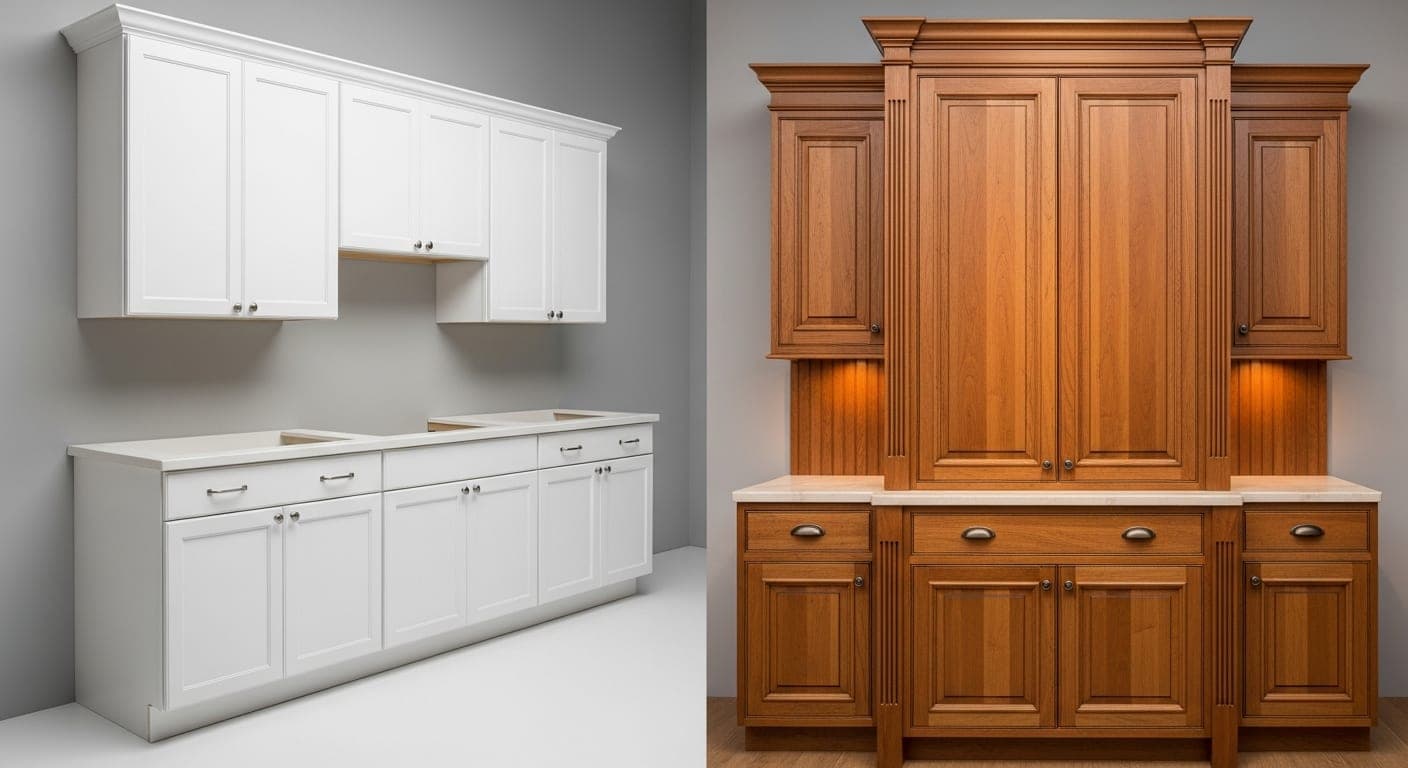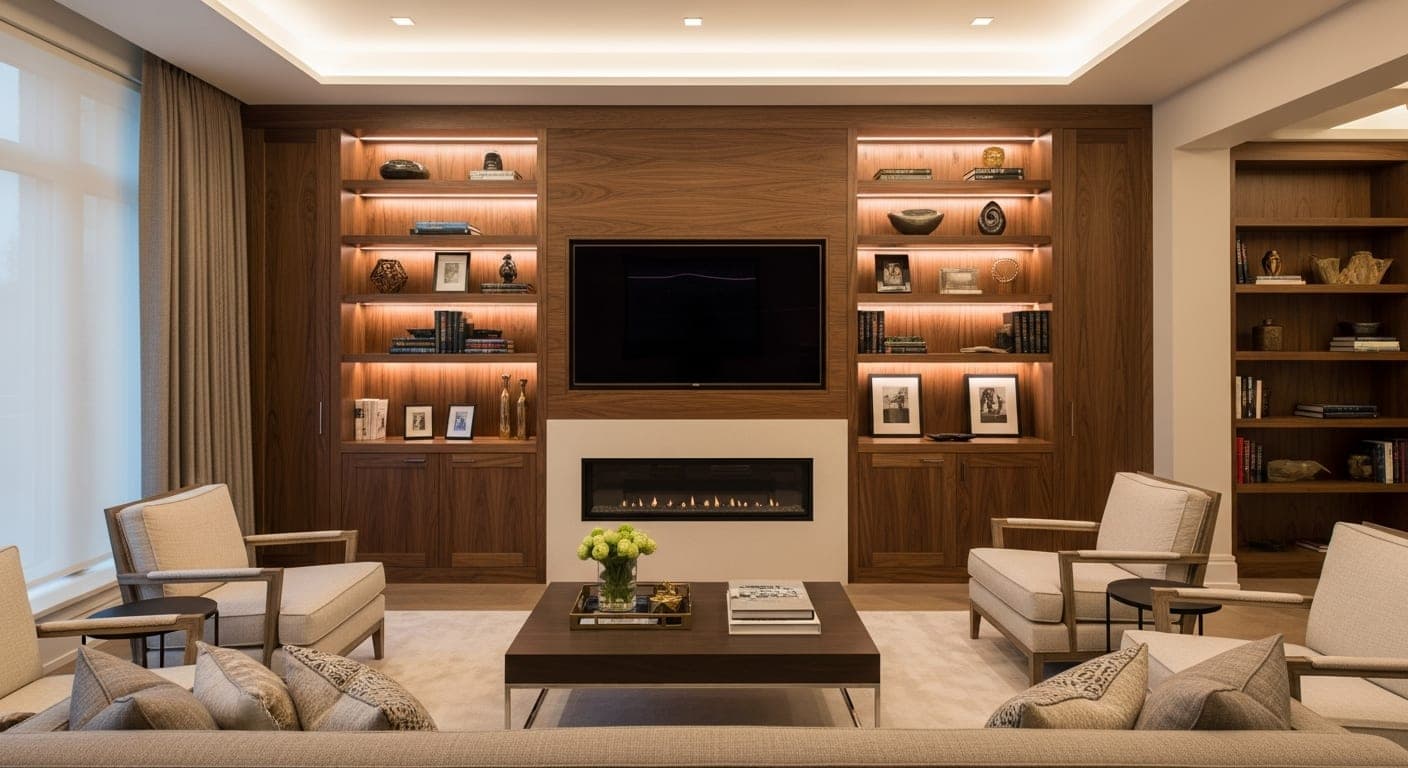
Two requests account for most of the entertainment units we build: the full media wall, where every piece of equipment disappears into cabinetry, and the fireplace media wall, where the TV and cabinetry are built around a fireplace. Both have quietly replaced the TV stand, and for good reason: a stand holds a television, while a built media wall organizes the entire room.
Here is how we approach each, along with the details that separate a media wall that works from one that just photographs well.
The Full Media Wall
The brief is almost always the same: "I want to see the TV and nothing else." That means closed cabinetry below for consoles, receivers, and the accumulated tangle of remotes and controllers, with the wall above given to the screen, display shelving, or clean panelling.
The proportions matter more than the styling. We size the closed storage around your actual equipment, measured piece by piece, so nothing sits on top of anything else and every component has its own ventilated bay. Doors conceal it all; the section below the TV reads as one calm surface.
The Fireplace Media Wall
Cabinetry flanking a fireplace with the TV above it is one of the two configurations we are asked to build most. It is also the one where small dimensional decisions have the biggest consequences.
Fireplace clearances come first: gas, electric, and wood-burning units each have their own safety requirements, and we make that call per project before any design work hardens. Then comes TV height, where we will happily talk a client down from mounting the screen too high. Heat and viewing comfort both argue for keeping the screen as low as the fireplace allows; craning your neck at your own sofa is a renovation regret nobody mentions in the showroom.
Invisible Performance: Cooling and Connectivity
The best entertainment units do their real work invisibly. Modern electronics generate significant heat, and sealing them behind doors without airflow is a recipe for early failure. We install silent, temperature-gauged fans that activate only when a console or receiver warms up, moving hot air out of the cabinetry before it becomes a problem. Next to a fireplace, this is not optional.
Connectivity gets the same treatment: IR repeaters let your remote work through solid doors, and concealed cable chases carry everything out of sight. Clean fronts, full control.
Lighting That Earns Its Keep
Integrated LED lighting is the least expensive thing on this list and the one clients notice every evening. Strips behind panels or in shelf channels give the wall depth and a warm glow that makes the room usable at night without overhead lights.
The catch is sequencing: the wiring has to be planned at the design stage so it runs inside the millwork, invisibly, before finishing. Added afterwards, it is surface-mounted and it shows. Put it on a dimmer and keep the colour temperature warm; a media wall lit like a retail display defeats the purpose.
Condo Units: Working With Concrete
Toronto condos add a constraint that catches people off guard: you usually cannot chase wiring into a concrete slab or a demising wall. A custom unit solves this by carrying its own infrastructure, with cable routes and power management built inside the millwork. Handle-free fronts and a restrained material palette suit condo proportions, and a floating lower cabinet keeps the floor line visible, which makes a compact living room feel larger.
Materials That Age Well
For stained wood walls, we veneer-match across door fronts so the grain runs continuously through the whole elevation, which is the detail that makes a large unit read as one piece of architecture instead of a row of cabinets. Painted units get our premium spray finish in any colour. High-gloss still suits some modern condos, though we build noticeably less of it than a few years ago; it shows fingerprints around the most-touched doors, which matters on the cabinet you open every single evening.
If you are weighing a built unit against freestanding furniture, we wrote a direct comparison in custom wall units vs. store-bought furniture.
Ready to design a custom entertainment unit for your living room? Request a free consultation to see how a custom wall unit can organize the whole room, not just hold the TV.